Letting Go of the Need for Certainty
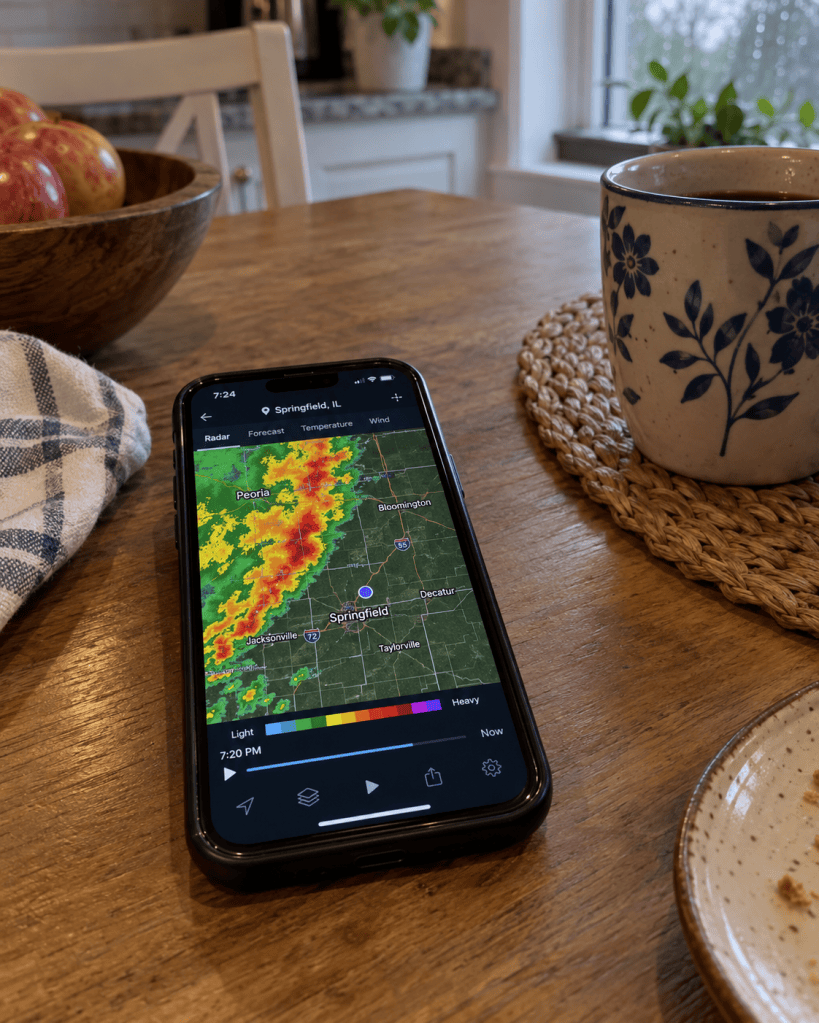
We had a storm come through here a while back. When I was younger, I checked the radar eleven times in about two hours. The storm did what the storm was going to do. What I accomplished was experiencing it eleven times instead of once, plus a low-grade dread through the whole evening that I could have skipped entirely.
That’s certainty-seeking in miniature, and most of us are doing a version of it constantly.
What certainty-seeking looks like
Checking. Radar, tracking, bank balance, his location, the symptom, the test result page, the email you already sent.
Researching. Three hours on the internet about a thing a doctor will tell you in six minutes. The forums are the worst of it, because a forum is a collection of the people it went badly for.
Asking. Are you mad at me. Do you think it’s fine. Are we okay. Once is a fair question. The fourth time in a day is a different behavior entirely.
Rehearsing. Running the conversation in advance so you’ll be prepared for every branch. This masquerades as preparation and it’s really an attempt to pre-live an event so it can’t surprise you.
Deciding early. Ending it, quitting, or choosing the bad certain thing over the good uncertain one just to close the loop.
Why it makes things worse
Every one of those produces relief, which is exactly the problem.
Relief is a reward, and rewarded behavior repeats and escalates. So the checking that used to take once a day takes four times a day by spring. The reassurance that held you for an hour holds you for twenty minutes by the fall.
Meanwhile, the underlying tolerance for not knowing gets weaker, because you never practice it. Every time you resolve the discomfort with a check, you teach your system that it couldn’t have handled the not-knowing.
That’s how a person ends up unable to sit with a normal open question that other people don’t even notice.
What you’re actually after
Nobody wants certainty for its own sake. What people want is to stop feeling the dread.
Here’s the honest bad news. Certainty is not available. This certainty we crave isn’t available about your health, your marriage, your kids, your job, or tomorrow. It never was, for anybody, ever. The people who seem calm about the future aren’t calm because they know something. They’ve got a higher tolerance for not knowing.
That tolerance is the actual goal, and it’s trainable.
Building tolerance
Delay before you check. Not never. Just later. Ten minutes, then an hour. You’re teaching your system that the discomfort passes on its own. Which it does. However, it can never demonstrate while you keep cutting it short.
Cut reassurance to one ask. Tell your husband what you’re doing. Then ask him to answer once. Lastly remind him to say “I love you and I already answered that.” Not cruelty. A ladder.
Put the research on a leash. One reputable source, ten minutes, then write down your actual question for the actual professional. Forums are not data.
Follow the what-if all the way down instead of shoving it away. Where would I live. Who would I call. What would I do on day one. Specific catastrophes are smaller than vague ones, almost every time.
Notice the payoff you’re getting. Certainty-seeking often gives a person a feeling of doing something. If you can find another action that’s real, even a small one, the urge loses a lot of its grip.
The faith piece, honestly
I’m not going to hand you a verse as a sedative.
What I’ll say is that faith, in my experience, has never once removed the uncertainty. That’s not what it does. What it changes is who’s holding the open question while I’m not able to.
There’s a difference between not knowing in an indifferent universe and not knowing while being held by somebody who does. That difference doesn’t answer the question. It changes what the question costs.
On the days I can’t feel any of that, I do the next small right thing and let the rest catch up.
The practical version
Pick your most frequent check. Not the scariest, the most frequent.
Cut it in half this week. If it’s eight times a day, make it four. Write down what happened, because you will not otherwise believe that nothing did.
Then cut it again in two weeks.
You’re not aiming for zero and you’re not aiming to stop caring. You’re aiming for a life where an open question can sit in the room with you without needing to be closed before you can go to bed.
The radar says what the radar says. Go sit on the porch and watch it come in.
This is education, not therapy. If you’re in crisis, call or text 988 for the Suicide and Crisis Lifeline. If you’re in Kentucky and tired of running two lives, come sit down with me. Circle of Hope Counseling Services.
Related Posts
Strength Looks Different in This Season
