Why Emotions Feel Like Facts (Even When They Aren’t)
“I feel like a terrible mother, so I must be one.” Not only have I said those words, I’ve heard some version of that sentence more times than I could count. Sometimes it’s “I feel like a failure.” Other times it’s “I feel like he doesn’t love me anymore,” or “I feel like something bad is about to happen.” The words change. The logic underneath them doesn’t: if I feel it this strongly, it has to be true.
There’s a name for that, and once you learn it, you’ll start catching it everywhere.
What emotional reasoning is
Emotional reasoning is when we treat a feeling as evidence. Dr. Aaron Beck described it in his early work on depression, and Dr. David Burns put it on his well-known list of thinking traps in his book Feeling Good. The short version goes, “I feel it, so it must be real.”
A few examples:
- I feel guilty, so I must have done something wrong.
- I feel overwhelmed, so this problem must be impossible.
- I feel anxious about the trip, so the trip must be dangerous.
- I feel unlovable, so I must be unlovable.
Look at that last one for a minute. A feeling went in one end and came out the other end as a fact about who you are.
Why feelings are so convincing
Feelings get there first. Your body reacts before your thinking brain has finished its sentence. Heart rate climbs, your chest gets heavy, your face gets hot, and by the time you start trying to reason it out, your whole body has already voted.
There’s an old study I love that shows how sneaky this is. Back in 1983, researchers Norbert Schwarz and Gerald Clore called people on the phone and asked how satisfied they were with their lives. People reached on sunny days rated their whole lives as better than people reached on rainy days. When the interviewer casually mentioned the weather first, most of that difference went away. People were reading their mood and mistaking it for information about their life.
If the weather can do that, imagine what grief can do. What about a hard childhood. Maybe it is three nights of bad sleep.
Where it comes from
Some of us learned emotional reasoning young. If you grew up in a house where one person’s mood decided whether it was a safe day or a bad day, you learned to read feelings like a weather report. That was smart. It kept you safe, and back then your feelings really were giving you accurate information about real danger.
The trouble is that the old radar doesn’t always know it’s not 1994 anymore. It still goes off at full volume when your boss sends a two-word email.
Feelings are real, but they’re not the judge
I’m not about to tell you your feelings don’t count. They count. They’re telling you something true about what’s happening inside you. A feeling of guilt might be pointing at something you really do need to make right. Anxiety might be picking up on something your mind hasn’t caught yet.
But a feeling mostly reports on your inside world. It doesn’t always give an accurate report on the outside world. Feeling like a burden is real pain. Being a burden is a whole separate claim, and it needs its own evidence.
A heart that condemns
I love that the Bible doesn’t pretend our hearts always tell us the truth. First John 3:20 says, “For if our heart condemns us, God is greater than our heart, and knows all things.”
Read that slowly if you live with a heavy, accusing feeling that never seems to get the memo. Your heart might be condemning you. God is greater than that feeling, and He has more information than it does. He knows the whole story, including the parts your guilt conveniently leaves out.
Questions to sit with
- What feeling do you most often treat like a fact?
- When you were growing up, whose feelings decided how the day would go?
- Is there a feeling about yourself that you’ve never once questioned?
One small step
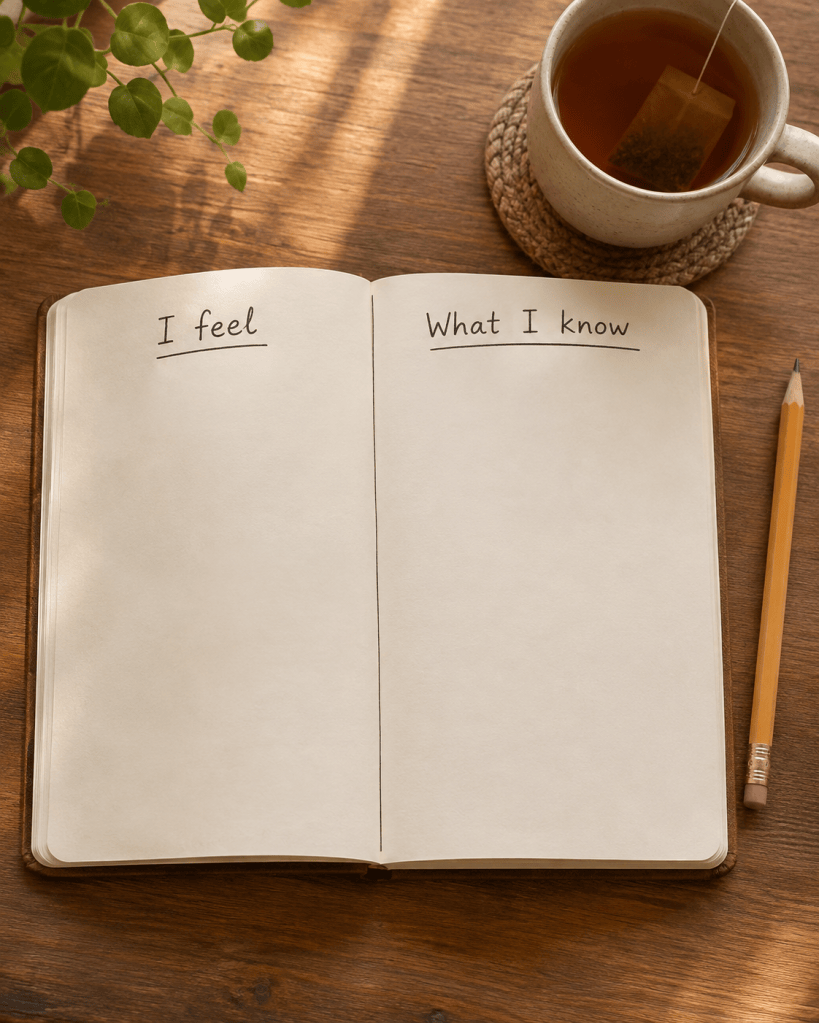
Draw a line down the middle of a page. On the left side, write “I feel…” and finish the sentence with something that’s been heavy on you. On the right, write “What I actually know is…” and list only the things you could prove to a stranger. No guesses, no predictions, no “everybody thinks.” Then look at both sides and notice where they match and where they don’t.
You don’t have to throw the feeling away. You’re just asking it to stand next to the facts for a minute.
Let’s walk this together
If your feelings have been handing down verdicts you can’t seem to argue with, you don’t have to sort it out alone. I see individuals, couples, families, and teens at Circle of Hope Counseling Services, in person in Paducah and by telehealth across Kentucky.
This post is for education and encouragement. It isn’t therapy, and it doesn’t replace care from a licensed professional who knows your story. If you’re in crisis or having thoughts of suicide, call or text 988 to reach the 988 Suicide and Crisis Lifeline, any time, day or night. If you’re in immediate danger, call 911.
Related Posts
When Control Starts Running Your Life
