Boundaries Are Not Walls
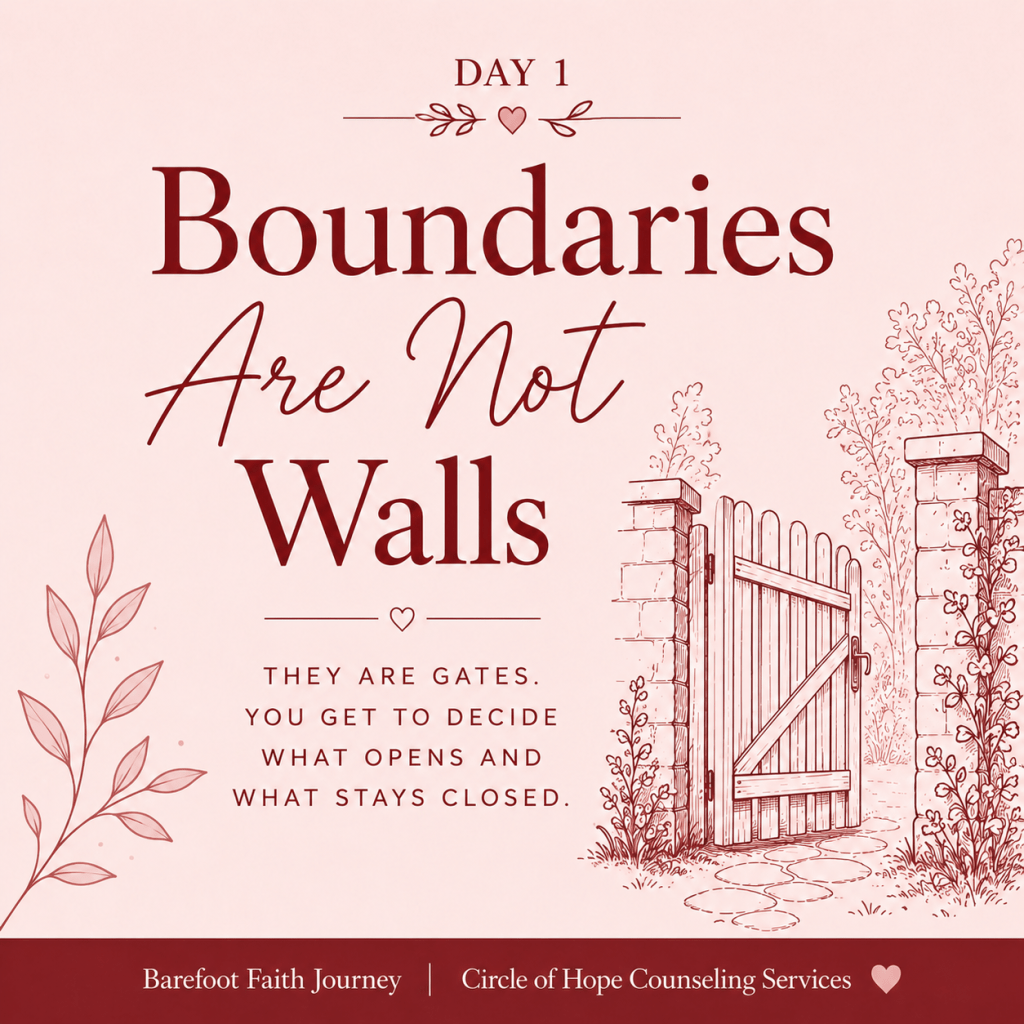
For a long time, a lot of people hear the word boundaries and immediately picture shutting people out. Walls, distance, coldness, cutting people off, being mean.
But healthy boundaries are not walls, and they’re not weapons or punishments either. Boundaries are simply the lines that define what is safe, healthy, and sustainable in your life. A boundary says, “This is where I end and you begin.”
That line matters, because without it we confuse love with overextending, kindness with self-abandonment, forgiveness with pretending nothing hurt, and peacekeeping with silence.
Most people who struggle with boundaries are not selfish. They’re usually the most caring people in the room, the ones who show up, answer the phone, give one more chance, explain one more time, and carry one more burden trying to make the relationship work. But eventually the body starts telling the truth. Resentment creeps in. The phone rings and your stomach drops. Every interaction leaves you drained, you rehearse conversations in the shower, and you keep saying yes while quietly falling apart. That’s not peace, and it’s not love. That’s survival.
Boundaries are one of the ways we come out of survival mode. They help us stop living like everyone else’s comfort outranks our emotional, spiritual, and physical health, and they remind us that being a Christian does not mean having no limits.
Even Jesus had boundaries. He withdrew to quiet places and rested. He didn’t heal every person in every town, didn’t chase people who rejected Him, and spoke truth whether or not the crowd liked it. If Jesus, who was perfect love, still lived with limits, then limits aren’t the opposite of love. They may be part of it.
A healthy boundary may sound like:
“I am not able to talk about this right now.”
“I love you, but I cannot keep having this conversation if you are yelling.”
“I need time to think before I answer.”
“I cannot continue helping in a way that is harming me.”
“I am available for support, but I am not available to be blamed.”
Boundaries don’t mean you stop caring. They mean you stop carrying what was never yours to carry. They make room for honesty, give relationships a chance to get healthier, and help you tell the difference between compassion and plain emotional exhaustion.
And yes, sometimes boundaries will disappoint people. Especially the people who benefited from you not having any. That doesn’t make your boundary wrong. It usually just means the relationship is adjusting to a healthier pattern than the one it was used to.
Proverbs 4:23 says, “Above all else, guard your heart, for everything you do flows from it.” Guarding your heart doesn’t mean hardening it. It means stewarding it, and remembering your heart matters too.
You’re allowed to love people and still have limits, to be kind and still say no, to forgive and still require change. You can be soft-hearted without being endlessly accessible.
Because boundaries are not walls. They’re more like a screen door. A screen door lets the breeze in and keeps the bugs out, and you can still see who’s standing on the porch. It opens for who it should and stays latched for who it shouldn’t, and nobody drives past a house with a screen door and calls it a fortress.
Reflection Question: Where in your life have you confused having a boundary with being unkind?
Gentle Practice: Write down one area where you feel resentment, dread, or exhaustion. Ask yourself, “What limit might my heart be asking me to set?”
Closing Encouragement: You do not have to become hard to become healthy. You can stay tender and still learn to protect your peace.
