What Fall Teaches Us About Identity
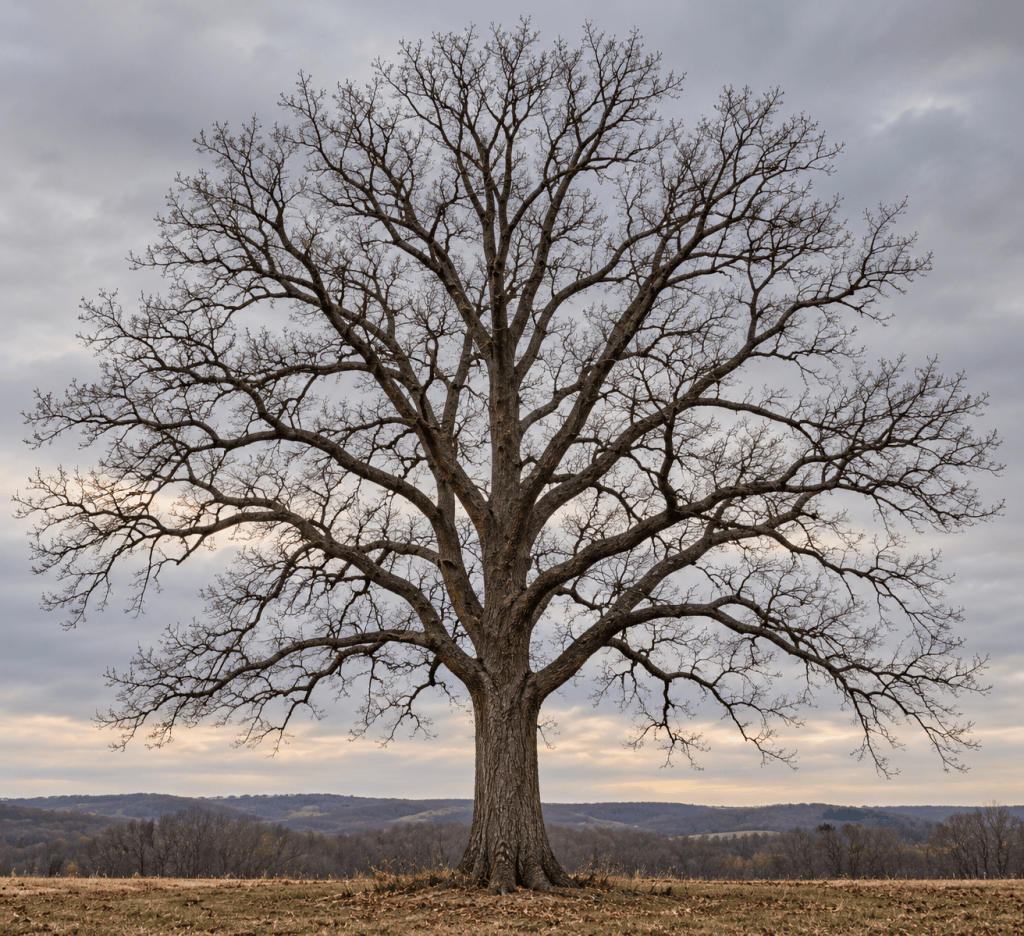
You can’t tell what shape a tree is in July. The leaves are in the way. Come November the structure’s right there, every fork and angle and the one heavy limb that grew out over the driveway, and you realize you’ve lived with this tree for eleven years and never seen it.
People are the same. What you do is the canopy. Nobody sees past it, including you, until something takes it off.
The identity audit nobody asks for
Try this. Answer “who are you” without naming a role, a job, a relationship, or an accomplishment.
Most people get about four seconds in and stall.
Nurse, mother, wife, church member, the dependable one, the funny one, the one who handles it. Every single one of those is a leaf. They’re all real, they’re all worth having, and they all come off, either by choice, by loss, or eventually by time.
If the whole structure runs on them, then a hard season doesn’t feel like change. It feels like erasure. And that’s the thing I hear most from people in the bare part. Not “I lost my job.” “I don’t know who I am.”
How we got built this way
Nobody sat down and decided to be a canopy person. It accumulated.
You got praised for output early. Grades, behavior, being easy, being good at something. Somewhere in there the message settled that you are what you produce, and it settled below the level where you could evaluate it.
Then the culture made it worse. First question at any gathering is what you do. Not who you love, what you’re curious about, what you’re like when nobody needs anything from you. What you do.
And church can layer another one on top, where your worth gets tangled up with service. Serving is good. Being unable to stop serving without feeling worthless is not the same thing, and I’ve seen more burned-out church women than I can count who couldn’t tell the difference anymore.
What’s underneath
When the leaves come off, here’s what’s actually there, and it takes people a long time to see it as anything.
Your temperament. How you’re wired, which has been the same since you were three. Quick to laugh or slow to warm. Needs people or needs quiet. That was there before any role.
What moves you. What makes you cry at things other people walk past. That’s structure, not decoration.
What you refuse. The things you won’t do even when it would be easier. Your actual lines. Most people have never inventoried these and they’re some of the strongest material in the whole tree.
What you’re curious about when nobody’s watching. The stuff you’d read about if you had a free afternoon and no assignment.
How you treat somebody who can’t do anything for you. That one tells you more than any job title ever will.
And if you’re a person of faith, the piece that was never a product in the first place. You were made, before you were useful. That’s not a slogan, it’s the order of operations, and it’s the only foundation I’ve found that doesn’t come off in a hard year.
What to do in the disorientation
Don’t rush to replace the leaf. The fastest way through identity loss feels like grabbing a new role immediately. New relationship, new job, new cause, new project. It works for a while, and then you’re right back here in a decade with less time.
Answer the “what do you do” question differently, on purpose, one time. See what it feels like. It’ll be uncomfortable and the discomfort is informative.
Do one thing a week that produces nothing. Not rest as recovery for more work. Something with no output at all. For a lot of us this is the hardest instruction in the whole series.
Notice when you’re auditioning. If you catch yourself running through your accomplishments in a conversation, that’s not vanity, that’s a structure checking whether it’s still standing.
Ask somebody who has known you a long time what you’re like. Not what you’re good at. What you’re like. Their answer is usually a description of the trunk, and it’s often the first time you’ll hear it.
The thing about that tree
Here’s what I’d want you to sit with.
The tree’s identity was never the leaves. It grew them and dropped them fifty times and was the same tree all fifty years. The leaves were something it did, not something it was, and it never got confused about that because it doesn’t have the kind of brain that gets confused about that.
We do. So we have to figure it out on purpose, and the only time we ever get the chance is a season like the one you’re in.
You are always more than enough, and that was true before you did a single thing worth mentioning.
This is education, not therapy. If you’re in crisis, call or text 988 for the Suicide and Crisis Lifeline. If you’re in Kentucky and don’t know who you are without the roles, that’s exactly the kind of work I love. Circle of Hope Counseling Services.
Related Posts
Why Your Body Remembers What Your Mind Tries to Forget
