Naming Emotions Without Judging Them
“How are you?”
“Fine.”
If I had a dollar for every time somebody told me they were fine right before they burst into tears on my couch, I could retire early. Fine isn’t a feeling. Fine is a closed door with a wreath on it.
A lot of us grew up with about three feelings in our vocabulary: mad, sad, and glad. Some of us only had two, fine and tired. So when something stirs inside us, we don’t have the words for it, and something without a name is awfully hard to work with.
Naming it actually does something
This isn’t just a feel-good idea. In 2007, Dr. Matthew Lieberman and his team at UCLA put people in brain scanners and showed them pictures of faces with strong emotional expressions. When people put a feeling word to what they saw, activity in the amygdala, the brain’s alarm center, went down. Meanwhile, activity went up in a part of the prefrontal cortex involved in regulating emotion.
Researchers call this affect labeling. Dr. Dan Siegel has a catchier name for it: name it to tame it.
The more precise, the better
Dr. Lisa Feldman Barrett and other researchers have studied something called emotional granularity, which is basically how finely you can tell your feelings apart. Some people just feel “bad.” Others can tell the difference between disappointed, embarrassed, lonely, and resentful. Research suggests that people with more detailed emotional vocabularies tend to handle their feelings better.
That makes sense when you think about it. If you only know you feel bad, you don’t know what you need. If you know you feel lonely, you know to call somebody. If you know you feel resentful, you can ask what boundary got crossed.
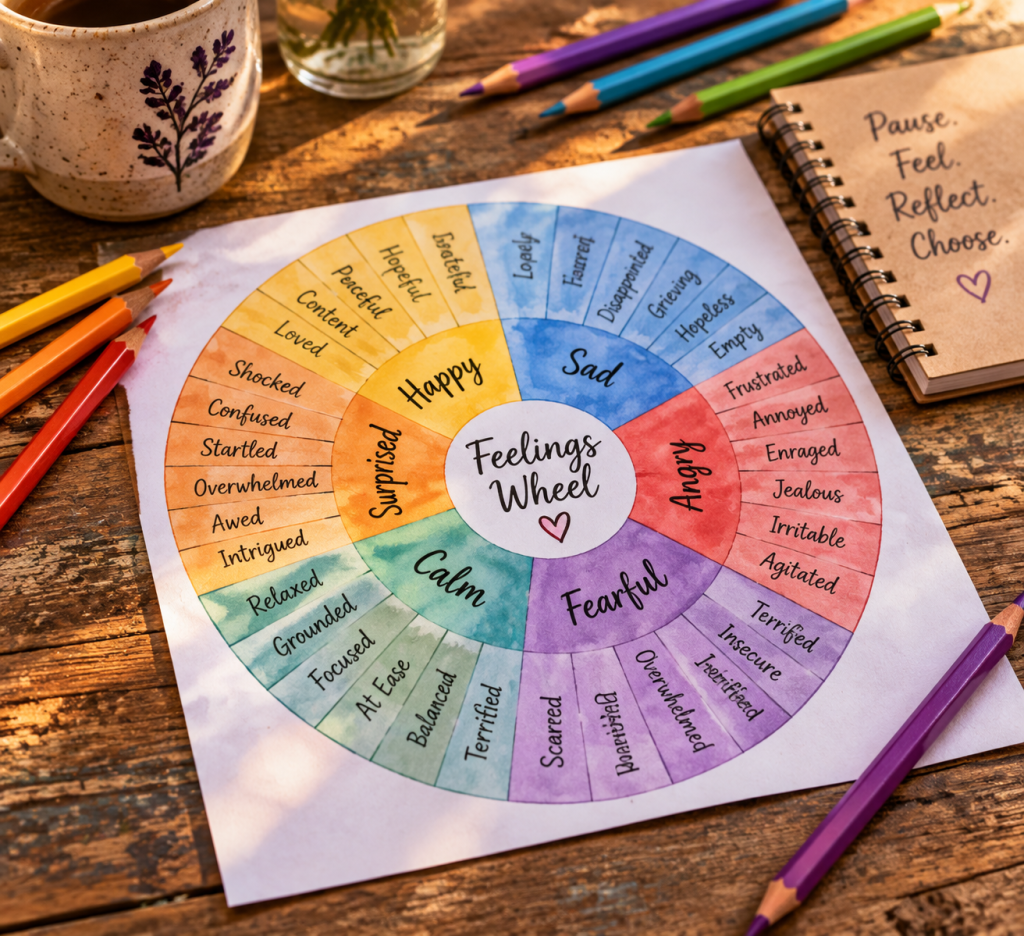
One tool I love for this is the feelings wheel, created by Dr. Gloria Willcox in 1982. It starts with a few core feelings in the middle and branches out to more specific ones around the edges. I keep copies in my office, and I’ve watched grown men find a word on that wheel and say, “That’s it. That’s what I’ve been feeling for a year.”
Without judging
Here’s the second half of this, and it matters just as much. Name the feeling without slapping a grade on it.
A lot of us don’t just feel anxious. We feel anxious and then feel stupid for being anxious. We feel sad and then feel guilty for being sad when other people have it worse. That second layer, the feeling about the feeling, piles a whole new load of pain on top of the first one.
Feelings aren’t good or bad. They’re information, like we talked about back in post twelve. What you do with them can be wise or unwise, but the feeling itself is just telling you something.
I like to say mental health is why there are colors in the rainbow. All those different feelings are colors, and that’s a beautiful thing, not a problem to fix. You weren’t made in black and white.
More than one at a time
One more thing that surprises people: you can feel two or three things at once, and they don’t have to agree with each other. You can be relieved your mama’s suffering is over and heartbroken that she’s gone. You can be proud of your kid for leaving home and lonely in the quiet house. Naming all of them, instead of picking the “right” one, is a big part of emotional honesty.
Hannah named it
In 1 Samuel 1, Hannah was praying in the temple, so overcome with grief that her lips were moving but no sound was coming out. The priest, Eli, assumed she was drunk and scolded her.
She didn’t hide what she felt. She said, “I am a woman of sorrowful spirit… but have poured out my soul before the LORD” (1 Samuel 1:15).
Someone misjudged her feelings, out loud and in public. She named them anyway, plainly and without apology. And God met her right there in that sorrow.
Questions to sit with
- What’s your go-to non-answer when someone asks how you are?
- Which feelings do you tend to judge yourself for having?
- How did the adults in your life talk about feelings when you were growing up?
One small step
Three times a day this week (maybe tie it to breakfast, lunch, and supper), stop and name what you’re feeling with a word more specific than fine, good, or bad. If you can, rate how strong it is from one to ten and notice where you feel it in your body. If you get stuck, look up a feelings wheel and print one out to keep on the fridge.
If you have kids, try this with them at supper. It’s one of the best gifts you can give them.
Let’s walk this together
If you’ve been living on fine for a long time and you’d like to find words for what’s really going on, I’d be honored to help. I work with individuals, couples, families, and teens at Circle of Hope Counseling Services, in person in Paducah and by telehealth across Kentucky.
This post is for education and encouragement. It isn’t therapy, and it doesn’t replace care from a licensed professional who knows your story. If you’re in crisis or having thoughts of suicide, call or text 988 to reach the 988 Suicide and Crisis Lifeline, any time, day or night. If you’re in immediate danger, call 911.
Related Posts
Peace Comes When You Stop Carrying What Isn’t Yours
