Fall Is Not the End, It’s the Preparation
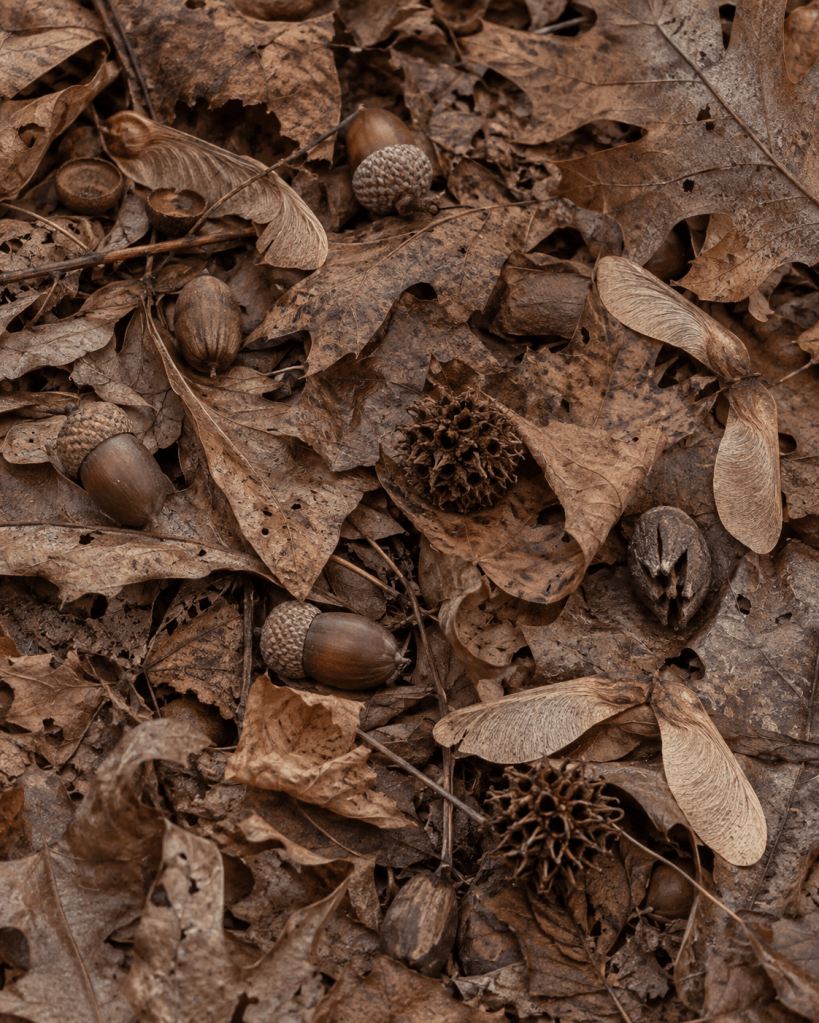
Everything a woods needs for next spring is already on the ground right now.
The acorns are down. The maple seeds spun off in October. The leaf litter that’s going to feed the whole system as it breaks down is lying there getting rained on. Every bud that opens in April is already built and sealed against the cold, sitting on branches that look completely finished.
None of it looks like preparation. It looks like debris.
The problem with calling it an ending
We read seasons wrong because we read them from inside a single frame.
Stand in a woods in November with no knowledge of how any of it works and you would conclude something died. The evidence is overwhelming. Everything is brown, nothing is moving, the whole place is quiet in a way it wasn’t in June.
You’d be looking at a system in the middle of its most important structural work and calling it a graveyard.
People do this to their own lives constantly, and the cost is real, because what you believe about the ending changes what you do next. If this is an ending, you start making decisions about the rest of your life from the worst possible vantage point.
What I’m not saying
I need to be careful here, because “it’s not an ending” can be used to shut people up.
Some things really do end. A marriage ends. A person dies and does not come back. The career you loved is over and there’s no second act coming in that field. A body that worked one way doesn’t work that way anymore.
I’m not asking you to deny any of that. I’m not telling you it happened for a reason, and I’m not going to attribute your loss to a plan, because I’ve sat with too many people who got handed things I refuse to call a gift.
What I’m saying is narrower and it’s the only version I can defend. The end of that thing is not the end of the story, and the flat part you’re in right now is doing work you can’t see.
How preparation actually works
It’s unglamorous and it happens in the wrong order from what we’d design.
First the stripping. Whatever can’t come with you comes off. Some of that is loss you’d never have chosen, and some of it is stuff you should have let go of years ago, and in the moment you can’t tell them apart.
Then the breaking down. The leaf litter isn’t stored, it’s decomposed, and the decomposing is what makes it useful. Your hard season is being processed into something, slowly, in a form you would not recognize as progress.
Then the hardening. Buds get built with a protective layer before winter, not after. Whatever capacity you’re going to have next year is being formed right now, in the cold, by a version of you who feels like she’s failing.
Then, much later, and on a schedule nobody consults you about, it opens.
You cannot skip a step and you cannot speed one up, and I have watched a lot of people try both.
Getting the most out of a preparation season
Don’t make permanent decisions in the flat part. Almost nothing has to be decided this winter. The view from here is not the view.
Keep something growing that you can see. One plant, one small project, one thing with visible progress. Not because it’s important, but because a person with zero visible growth for six months starts believing things that aren’t true.
Pay attention to what’s coming off. Some of what you’re losing you’ll want back and some you won’t, and the sorting is genuinely useful information about the life you’ve been living.
Tend the roots. Sleep, food, water, sunlight, one or two real people, and whatever your practice is. The unglamorous stuff is the whole job right now.
Write down what you’re learning while it’s still costing you something. Insight from a hard season fades fast once the season lifts. Get it on paper now and you’ll have something later that you can actually use, and maybe somebody else can too.
The part about hope
Hope has gotten a reputation as a soft thing, and I think that’s backwards. Hope is one of the more aggressive positions a person can take.
It means looking at a field of debris and holding, without proof, that this is not the final condition. Nothing about that is passive. It’s a stance you take against available evidence, and it costs something every day you maintain it.
Some days you won’t be able to. Those days are fine. Borrow somebody else’s for a while, which is one of the main things a church is supposed to be for and one of the main things I do for a living. When somebody can’t hold their own hope, I hold it for them until they can take it back.
One last thing about the acorns
Here’s what gets me every year.
An oak makes thousands of acorns and almost none of them become trees. The math is terrible. Squirrels, rot, mowers, bad ground.
And every fall, it makes thousands anyway.
You’ve had things not take. Plans that rotted, relationships that got mowed down, years that went nowhere. That’s the actual math of a life, and it doesn’t mean you were wrong to put anything in the ground.
Keep making acorns. Something’s going to take.
This is education, not therapy. If you’re in crisis, call or text 988 for the Suicide and Crisis Lifeline. If you’re in Kentucky and standing in a field of debris, I’d be glad to help you sort it. Circle of Hope Counseling Services.
Related Posts
When Gaslighting Makes You Doubt What Happened
