Suicide Deaths in the United States
Content Note:
This post discusses suicide, suicide loss, suicidal thoughts, grief, mental health, emotional pain, or crisis support. Please read with care. If this topic feels activating, it is okay to pause, step away, or reach out for support.
If you are in crisis, thinking about suicide, at risk of hurting yourself, or in immediate danger, call 911, call or text 988, or go to your nearest emergency room. This blog is not monitored for crisis support.
Suicide Is Not Just a Statistic
These are some powerful visuals from the Suicide Prevention Resource Center. The statistics are based on Suicide Deaths in the United States. Please, stop and take a look. More people have suicidal ideations than you think. Sadly, some of these people may be your family or friends.

From 2009 to 2018, the age-adjusted suicide death rate increased from 11.76 to 14.24 per 100,000 people. From 2009 to 2018, the rate increased from 19.23 to 22.79 per 100,000 for males. Among females, the rate increased from 4.88 in 2009 to 6.18 in 2018.
Suicides consistently outnumber homicides.

What the Numbers Cannot Show
The homicide rate has not consistently shown the upward trend that we see with the suicide rate.
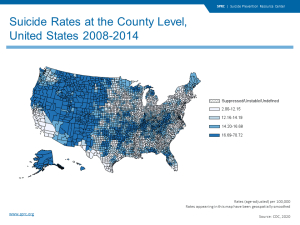
Suicide rates are generally highest in Alaska and in the western and northwestern United States, with the exception of southern California and parts of Washington. Rural counties generally have higher rates of suicide than urban counties.
Where to Find Help
- Centers for Disease Control and Prevention, National Center for Health Statistics. (2020). 1999-2018 Wide-Ranging Online Data for Epidemiological Research (WONDER), Multiple Cause of Death files [Data file]. Retrieved from CDC Underlying Cause
- Centers for Disease Control and Prevention. 2008-2014, United States Smoothed Age-Adjusted Death Rates per 100,000 Population [map]. All Injury, Suicide, All Races, All Ethnicities, Both Sexes, All Ages. (January 2020). Retrieved from CDC
- Rosen, L. M., Hedegaard, H., Kahn, D., & Warner, M. (2018). County-level trends in suicide rates in the U.S., 2005–2015. American Journal of Preventive Medicine [3], 55(1), 72-79.
Crisis Support Disclaimer:
This post is shared for awareness, education, encouragement, and stigma reduction. It is not therapy, clinical advice, crisis care, medical advice, diagnosis, or treatment. Reading this blog does not create a therapist-client relationship with Barefoot Faith Journey or Circle of Hope Counseling Services, LLC.
If you are in crisis, thinking about suicide, at risk of hurting yourself, or in immediate danger, call 911, call or text 988, or go to your nearest emergency room. You are worthy of immediate care and support.
Related Posts
Resources that Can Help with Suicide Prevention
